Max V. Golden, Matthew H Lee, John W Garrett, Shamsi Daneshvari Berry, Nicollette Appel, Ronald M. Summers, Heather J. H. Edgar, Perry J. Pickhardt
{"title":"AI-enabled body composition biomarkers at post-mortem CT for enriching autopsy: analysis of a large decedent cohort","authors":"Max V. Golden, Matthew H Lee, John W Garrett, Shamsi Daneshvari Berry, Nicollette Appel, Ronald M. Summers, Heather J. H. Edgar, Perry J. Pickhardt","doi":"10.1007/s00261-025-04878-z","DOIUrl":null,"url":null,"abstract":"<div><h3>Objective</h3><p>To correlate fully-automated PMCT-based body composition measures with causes of death and comorbidities.</p><h3>Materials and methods</h3><p>Retrospective study of New Mexico Decedent Image Database (NMDID) with non-contrast PMCT scans between 2010 and 2017. Automated pipeline of AI-driven algorithms for quantifying skeletal muscle, subcutaneous/visceral fat, and aortic calcification from the abdominal component of PMCT scans was used. Scans with more than minimal decomposition were excluded. Cause of death was categorized as “acute” or “chronic.” A predetermined model derived CT-based “biological age.”</p><h3>Results</h3><p>6638 decedents (mean age, 50±18 [SD]; 74% male) comprised the final cohort. 80% of deaths were classified as “acute,” 10% as “chronic,” and 10% “uncertain.” Muscle density (HU) and area at the L3 lumbar level were higher in the “acute” versus “chronic” group (26 HU vs. 18 HU, <i>p</i> < 0.001; 192 cm<sup>2</sup> vs. 183 cm<sup>2</sup>, <i>p</i> < 0.001). Muscle density and area at the L3 level were higher among those without cancer (25 HU vs. 16 HU, <i>p</i> < 0.001; 190 cm<sup>2</sup> vs. 169 cm<sup>2</sup>, <i>p</i> < 0.01). Aortic Agatston scores were higher in those who died of heart disease (5120 vs. 2098, <i>p</i> < 0.001). Diabetic patients had higher L3 visceral fat area (227 cm<sup>2</sup> vs. 175 cm<sup>2</sup>, <i>p</i> < 0.001) and lower muscle density (17 HU vs. 25 HU, <i>p</i> < 0.001). The deviation between chronological and biological age was significantly higher in the chronic versus acute group (median age deviation, 19 years vs. 10 years; <i>p</i> < 0.001).</p><h3>Conclusion</h3><p>Fully-automated quantitative PMCT-based tissue biomarkers correlate with the temporal nature of death and chronic co-morbidities, supporting their use for enhancing autopsies.</p><h3>Graphical abstract</h3><div><figure><div><div><picture><source><img></source></picture></div></div></figure></div></div>","PeriodicalId":7126,"journal":{"name":"Abdominal Radiology","volume":"50 10","pages":"5047 - 5058"},"PeriodicalIF":2.2000,"publicationDate":"2025-03-18","publicationTypes":"Journal Article","fieldsOfStudy":null,"isOpenAccess":false,"openAccessPdf":"","citationCount":"0","resultStr":null,"platform":"Semanticscholar","paperid":null,"PeriodicalName":"Abdominal Radiology","FirstCategoryId":"3","ListUrlMain":"https://link.springer.com/article/10.1007/s00261-025-04878-z","RegionNum":3,"RegionCategory":"医学","ArticlePicture":[],"TitleCN":null,"AbstractTextCN":null,"PMCID":null,"EPubDate":"","PubModel":"","JCR":"Q2","JCRName":"RADIOLOGY, NUCLEAR MEDICINE & MEDICAL IMAGING","Score":null,"Total":0}
引用次数: 0
Abstract
Objective
To correlate fully-automated PMCT-based body composition measures with causes of death and comorbidities.
Materials and methods
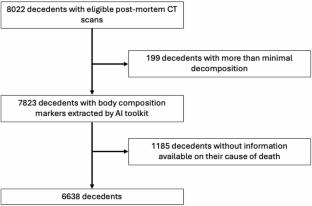
Retrospective study of New Mexico Decedent Image Database (NMDID) with non-contrast PMCT scans between 2010 and 2017. Automated pipeline of AI-driven algorithms for quantifying skeletal muscle, subcutaneous/visceral fat, and aortic calcification from the abdominal component of PMCT scans was used. Scans with more than minimal decomposition were excluded. Cause of death was categorized as “acute” or “chronic.” A predetermined model derived CT-based “biological age.”
Results
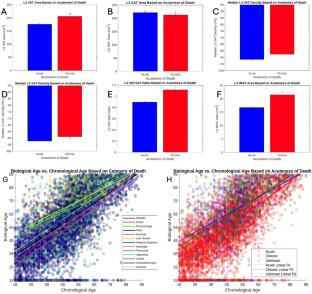
6638 decedents (mean age, 50±18 [SD]; 74% male) comprised the final cohort. 80% of deaths were classified as “acute,” 10% as “chronic,” and 10% “uncertain.” Muscle density (HU) and area at the L3 lumbar level were higher in the “acute” versus “chronic” group (26 HU vs. 18 HU, p < 0.001; 192 cm2 vs. 183 cm2, p < 0.001). Muscle density and area at the L3 level were higher among those without cancer (25 HU vs. 16 HU, p < 0.001; 190 cm2 vs. 169 cm2, p < 0.01). Aortic Agatston scores were higher in those who died of heart disease (5120 vs. 2098, p < 0.001). Diabetic patients had higher L3 visceral fat area (227 cm2 vs. 175 cm2, p < 0.001) and lower muscle density (17 HU vs. 25 HU, p < 0.001). The deviation between chronological and biological age was significantly higher in the chronic versus acute group (median age deviation, 19 years vs. 10 years; p < 0.001).
Conclusion
Fully-automated quantitative PMCT-based tissue biomarkers correlate with the temporal nature of death and chronic co-morbidities, supporting their use for enhancing autopsies.
目的:将全自动基于pmct的身体成分测量与死亡原因和合并症联系起来。材料与方法:回顾性研究2010年至2017年新墨西哥州死者图像数据库(NMDID)非对比PMCT扫描。使用人工智能驱动算法的自动化流水线,从PMCT扫描的腹部部分量化骨骼肌、皮下/内脏脂肪和主动脉钙化。超过最小分解的扫描被排除在外。死因分为“急性”和“慢性”。一个预先确定的模型衍生出基于ct的“生物年龄”。结果:6638例死亡,平均年龄50±18岁[SD];74%的男性)构成了最后的队列。80%的死亡被归类为“急性”,10%为“慢性”,10%为“不确定”。“急性”组与“慢性”组相比,L3腰椎水平的肌肉密度(HU)和面积更高(26 HU vs 18 HU, p2 vs 183 cm2, p2 vs 169 cm2, p2 vs 175 cm2, p)。结论:全自动定量pmct组织生物标志物与死亡的时间性质和慢性合共病相关,支持其用于加强尸检。
期刊介绍:
Abdominal Radiology seeks to meet the professional needs of the abdominal radiologist by publishing clinically pertinent original, review and practice related articles on the gastrointestinal and genitourinary tracts and abdominal interventional and radiologic procedures. Case reports are generally not accepted unless they are the first report of a new disease or condition, or part of a special solicited section.
Reasons to Publish Your Article in Abdominal Radiology:
· Official journal of the Society of Abdominal Radiology (SAR)
· Published in Cooperation with:
European Society of Gastrointestinal and Abdominal Radiology (ESGAR)
European Society of Urogenital Radiology (ESUR)
Asian Society of Abdominal Radiology (ASAR)
· Efficient handling and Expeditious review
· Author feedback is provided in a mentoring style
· Global readership
· Readers can earn CME credits




 京公网安备 11010802042870号
京ICP备2023020795号-1
京公网安备 11010802042870号
京ICP备2023020795号-1

 分享
分享
 求助内容:
求助内容: 应助结果提醒方式:
 扫码关注我们
