{"title":"An instant polymer “coffee”: Facilitating the dissolution of high-molecular-weight water-soluble polymers","authors":"Shiyuan Wang, Zhenghua Sun, Xiaoqin Cao, Yujun Feng, Hongyao Yin","doi":"10.1016/j.polymer.2025.128300","DOIUrl":null,"url":null,"abstract":"<div><div>Water-soluble polymers have been widely employed across various industries due to their exceptional thickening power. However, the dissolution of these high-molecular-weight polymers often encounters challenges including prolonged dissolution time, additional heating requirements, and incomplete solubilization, which result in inefficiency, energy wastage, and reduced thickening performance. Herein, an oil-based instant polymer dispersion consisting with ultra-high molecular weight polyacrylamide powder, Span-85, white oil, and nano-montmorillonite was developed to address these concerns. It was found that the dissolution rate of the polyacrylamide was significantly accelerated in brine solutions, such as saturated NaCl solution, 20 % CaCl<sub>2</sub> solution, and simulated seawater when using this polymer dispersion. The dissolution time could be reduced by up to approximately 80 % compared to that of the traditional polymer powder. The Span-85 and white oil were found to serve as barriers between polymer particles, thereby preventing their aggregation during dissolution. In addition, the dissolution process of the suspension was examined from a microscopic perspective through multiple light scattering techniques. The key factors influencing the dissolution rate were also discussed in detail. This polymer dispersion exhibits similar characteristics to instant coffee in terms of its rapid and effective dissolution properties, which not only conserves heating energy but also improves efficiency. With these advantages, the oil-based polymer dispersion is promising to act as high efficiency and sustainable solution for large scale polymer dissolution in industrial practice.</div></div>","PeriodicalId":405,"journal":{"name":"Polymer","volume":"325 ","pages":"Article 128300"},"PeriodicalIF":4.5000,"publicationDate":"2025-04-22","publicationTypes":"Journal Article","fieldsOfStudy":null,"isOpenAccess":false,"openAccessPdf":"","citationCount":"0","resultStr":null,"platform":"Semanticscholar","paperid":null,"PeriodicalName":"Polymer","FirstCategoryId":"92","ListUrlMain":"https://www.sciencedirect.com/science/article/pii/S0032386125002861","RegionNum":2,"RegionCategory":"化学","ArticlePicture":[],"TitleCN":null,"AbstractTextCN":null,"PMCID":null,"EPubDate":"2025/3/19 0:00:00","PubModel":"Epub","JCR":"Q2","JCRName":"POLYMER SCIENCE","Score":null,"Total":0}
引用次数: 0
Abstract
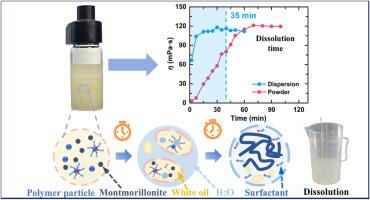
Water-soluble polymers have been widely employed across various industries due to their exceptional thickening power. However, the dissolution of these high-molecular-weight polymers often encounters challenges including prolonged dissolution time, additional heating requirements, and incomplete solubilization, which result in inefficiency, energy wastage, and reduced thickening performance. Herein, an oil-based instant polymer dispersion consisting with ultra-high molecular weight polyacrylamide powder, Span-85, white oil, and nano-montmorillonite was developed to address these concerns. It was found that the dissolution rate of the polyacrylamide was significantly accelerated in brine solutions, such as saturated NaCl solution, 20 % CaCl2 solution, and simulated seawater when using this polymer dispersion. The dissolution time could be reduced by up to approximately 80 % compared to that of the traditional polymer powder. The Span-85 and white oil were found to serve as barriers between polymer particles, thereby preventing their aggregation during dissolution. In addition, the dissolution process of the suspension was examined from a microscopic perspective through multiple light scattering techniques. The key factors influencing the dissolution rate were also discussed in detail. This polymer dispersion exhibits similar characteristics to instant coffee in terms of its rapid and effective dissolution properties, which not only conserves heating energy but also improves efficiency. With these advantages, the oil-based polymer dispersion is promising to act as high efficiency and sustainable solution for large scale polymer dissolution in industrial practice.
期刊介绍:
Polymer is an interdisciplinary journal dedicated to publishing innovative and significant advances in Polymer Physics, Chemistry and Technology. We welcome submissions on polymer hybrids, nanocomposites, characterisation and self-assembly. Polymer also publishes work on the technological application of polymers in energy and optoelectronics.
The main scope is covered but not limited to the following core areas:
Polymer Materials
Nanocomposites and hybrid nanomaterials
Polymer blends, films, fibres, networks and porous materials
Physical Characterization
Characterisation, modelling and simulation* of molecular and materials properties in bulk, solution, and thin films
Polymer Engineering
Advanced multiscale processing methods
Polymer Synthesis, Modification and Self-assembly
Including designer polymer architectures, mechanisms and kinetics, and supramolecular polymerization
Technological Applications
Polymers for energy generation and storage
Polymer membranes for separation technology
Polymers for opto- and microelectronics.




 京公网安备 11010802042870号
京ICP备2023020795号-1
京公网安备 11010802042870号
京ICP备2023020795号-1

 分享
分享
 求助内容:
求助内容: 应助结果提醒方式:
 扫码关注我们
