Jingxuan Zhang, Yeming Huang, Renhong Wang, Sirun Zhang, Dunju Wang
{"title":"Efficient 3D printing of RDX composites with high relative density via photocuring energetic polymers","authors":"Jingxuan Zhang, Yeming Huang, Renhong Wang, Sirun Zhang, Dunju Wang","doi":"10.1016/j.polymer.2025.128301","DOIUrl":null,"url":null,"abstract":"<div><div>Various countries have highly valued 3D printing technology due to its ability to achieve precise control and accurate formation of specialized and functional explosive structures, which changes the traditional manufacturing concept and improves the level of continuous, automated, integrated, and flexible manufacturing of explosives. However, the energy loss during 3D printing of energy-containing materials and the destruction of the inter-particle network during extrusion have become key issues restricting their development. As one of the key components of explosives 3D printing, the binder has a critical role in the molding speed, stability, and structural stability of explosives formulations. In this paper, the energy loss of the explosives’ printing process was effectively weakened by the addition of an energy-containing binder. The UV-assisted direct ink writing is used for 3D printing of PUA/PGN/RDX explosive formulations, which effectively avoids the problem of easy destruction of the particle network when the material is extruded. The experimental results show that the formulation has good rheological properties and high relative density. The printed samples are tightly linked and uniformly dispersed between particles under SEM observation, and the formulation has excellent exothermic properties, as demonstrated by DSC and combustion tests. The introduction of energy-containing binders can stimulate the development of extensive 3D printing of energy-containing materials and diverse printing methods.</div></div>","PeriodicalId":405,"journal":{"name":"Polymer","volume":"325 ","pages":"Article 128301"},"PeriodicalIF":4.5000,"publicationDate":"2025-04-22","publicationTypes":"Journal Article","fieldsOfStudy":null,"isOpenAccess":false,"openAccessPdf":"","citationCount":"0","resultStr":null,"platform":"Semanticscholar","paperid":null,"PeriodicalName":"Polymer","FirstCategoryId":"92","ListUrlMain":"https://www.sciencedirect.com/science/article/pii/S0032386125002873","RegionNum":2,"RegionCategory":"化学","ArticlePicture":[],"TitleCN":null,"AbstractTextCN":null,"PMCID":null,"EPubDate":"2025/3/19 0:00:00","PubModel":"Epub","JCR":"Q2","JCRName":"POLYMER SCIENCE","Score":null,"Total":0}
引用次数: 0
Abstract
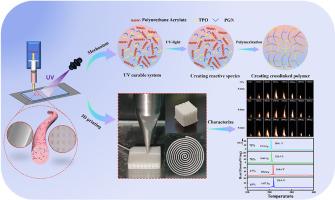
Various countries have highly valued 3D printing technology due to its ability to achieve precise control and accurate formation of specialized and functional explosive structures, which changes the traditional manufacturing concept and improves the level of continuous, automated, integrated, and flexible manufacturing of explosives. However, the energy loss during 3D printing of energy-containing materials and the destruction of the inter-particle network during extrusion have become key issues restricting their development. As one of the key components of explosives 3D printing, the binder has a critical role in the molding speed, stability, and structural stability of explosives formulations. In this paper, the energy loss of the explosives’ printing process was effectively weakened by the addition of an energy-containing binder. The UV-assisted direct ink writing is used for 3D printing of PUA/PGN/RDX explosive formulations, which effectively avoids the problem of easy destruction of the particle network when the material is extruded. The experimental results show that the formulation has good rheological properties and high relative density. The printed samples are tightly linked and uniformly dispersed between particles under SEM observation, and the formulation has excellent exothermic properties, as demonstrated by DSC and combustion tests. The introduction of energy-containing binders can stimulate the development of extensive 3D printing of energy-containing materials and diverse printing methods.
期刊介绍:
Polymer is an interdisciplinary journal dedicated to publishing innovative and significant advances in Polymer Physics, Chemistry and Technology. We welcome submissions on polymer hybrids, nanocomposites, characterisation and self-assembly. Polymer also publishes work on the technological application of polymers in energy and optoelectronics.
The main scope is covered but not limited to the following core areas:
Polymer Materials
Nanocomposites and hybrid nanomaterials
Polymer blends, films, fibres, networks and porous materials
Physical Characterization
Characterisation, modelling and simulation* of molecular and materials properties in bulk, solution, and thin films
Polymer Engineering
Advanced multiscale processing methods
Polymer Synthesis, Modification and Self-assembly
Including designer polymer architectures, mechanisms and kinetics, and supramolecular polymerization
Technological Applications
Polymers for energy generation and storage
Polymer membranes for separation technology
Polymers for opto- and microelectronics.





 京公网安备 11010802042870号
京ICP备2023020795号-1
京公网安备 11010802042870号
京ICP备2023020795号-1

 分享
分享
 求助内容:
求助内容: 应助结果提醒方式:
 扫码关注我们
