Engineered Hollow Nanocomplex Combining Photothermal and Antioxidant Strategies for Targeted Tregs Depletion and Potent Immune Activation in Tumor Immunotherapy
Qi Sun, Yuyan Wang, Hetian Ren, Shiyuan Hou, Kaiyi Niu, Liu Wang, Siyu Liu, Jingyi Ye, Chunying Cui, Xianrong Qi
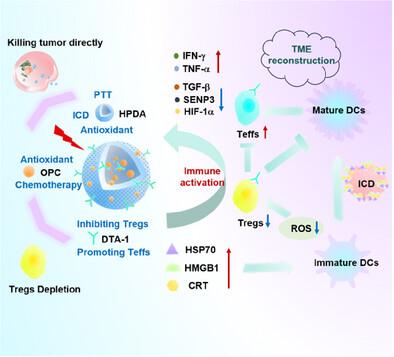
{"title":"Engineered Hollow Nanocomplex Combining Photothermal and Antioxidant Strategies for Targeted Tregs Depletion and Potent Immune Activation in Tumor Immunotherapy","authors":"Qi Sun, Yuyan Wang, Hetian Ren, Shiyuan Hou, Kaiyi Niu, Liu Wang, Siyu Liu, Jingyi Ye, Chunying Cui, Xianrong Qi","doi":"10.1002/adhm.202405124","DOIUrl":null,"url":null,"abstract":"<p>In the tumor immunosuppressive microenvironment (TIME), regulatory T cells (Tregs) critically suppress anticancer immunity, characterized by high expression of glucocorticoid-induced TNF receptor (GITR) expression and sensitivity to reactive oxygen species (ROS). This study develops a near-infrared (NIR)-responsive hollow nanocomplex (HPDA-OPC/DTA-1) using hollow polydopamine nanoparticles (HPDA), endowed with thermogenic and antioxidative properties, specifically targeting Tregs to activate antitumor immunity. The GITR agonist DTA-1, combined with the antioxidant oligomeric proanthocyanidins (OPC) to deplete Tregs. However, Tregs depletion alone may not sufficiently trigger robust immune responses. The HPDA nanocarrier enhances thermogenic and antioxidative capacities, supporting photothermal immunotherapy. The HPDA-OPC/DTA-1 demonstrates NIR responsiveness for both photothermal therapy (PTT) and OPC release, while facilitating Tregs depletion via DTA-1 and reducing ROS levels, thereby reviving antitumor immunity. Notably, intratumoral CD4<sup>+</sup>CD25<sup>+</sup>FOXP3<sup>+</sup> Tregs exhibited a 4.08-fold reduction alongside a 49.11-fold increase in CD8<sup>+</sup> T cells/Tregs relative to controls. Enhanced dendritic cells (DCs) maturation and immunogenic cell death (ICD) induction further demonstrate that HPDA-OPC/DTA-1 alleviates immunosuppression and activates antitumor immunity. Ultimately, the observed tumor inhibitory effect (tumor volume: 6.75-fold versus the control) and an over 80% survival rate highlight the therapeutic potential of combining Tregs targeting, antioxidant strategy, and photothermal immunotherapy for effective cancer treatment.</p>","PeriodicalId":113,"journal":{"name":"Advanced Healthcare Materials","volume":"14 15","pages":""},"PeriodicalIF":9.6000,"publicationDate":"2025-03-20","publicationTypes":"Journal Article","fieldsOfStudy":null,"isOpenAccess":false,"openAccessPdf":"","citationCount":"0","resultStr":null,"platform":"Semanticscholar","paperid":null,"PeriodicalName":"Advanced Healthcare Materials","FirstCategoryId":"5","ListUrlMain":"https://advanced.onlinelibrary.wiley.com/doi/10.1002/adhm.202405124","RegionNum":2,"RegionCategory":"医学","ArticlePicture":[],"TitleCN":null,"AbstractTextCN":null,"PMCID":null,"EPubDate":"","PubModel":"","JCR":"Q1","JCRName":"ENGINEERING, BIOMEDICAL","Score":null,"Total":0}
引用次数: 0
Abstract
In the tumor immunosuppressive microenvironment (TIME), regulatory T cells (Tregs) critically suppress anticancer immunity, characterized by high expression of glucocorticoid-induced TNF receptor (GITR) expression and sensitivity to reactive oxygen species (ROS). This study develops a near-infrared (NIR)-responsive hollow nanocomplex (HPDA-OPC/DTA-1) using hollow polydopamine nanoparticles (HPDA), endowed with thermogenic and antioxidative properties, specifically targeting Tregs to activate antitumor immunity. The GITR agonist DTA-1, combined with the antioxidant oligomeric proanthocyanidins (OPC) to deplete Tregs. However, Tregs depletion alone may not sufficiently trigger robust immune responses. The HPDA nanocarrier enhances thermogenic and antioxidative capacities, supporting photothermal immunotherapy. The HPDA-OPC/DTA-1 demonstrates NIR responsiveness for both photothermal therapy (PTT) and OPC release, while facilitating Tregs depletion via DTA-1 and reducing ROS levels, thereby reviving antitumor immunity. Notably, intratumoral CD4+CD25+FOXP3+ Tregs exhibited a 4.08-fold reduction alongside a 49.11-fold increase in CD8+ T cells/Tregs relative to controls. Enhanced dendritic cells (DCs) maturation and immunogenic cell death (ICD) induction further demonstrate that HPDA-OPC/DTA-1 alleviates immunosuppression and activates antitumor immunity. Ultimately, the observed tumor inhibitory effect (tumor volume: 6.75-fold versus the control) and an over 80% survival rate highlight the therapeutic potential of combining Tregs targeting, antioxidant strategy, and photothermal immunotherapy for effective cancer treatment.
期刊介绍:
Advanced Healthcare Materials, a distinguished member of the esteemed Advanced portfolio, has been dedicated to disseminating cutting-edge research on materials, devices, and technologies for enhancing human well-being for over ten years. As a comprehensive journal, it encompasses a wide range of disciplines such as biomaterials, biointerfaces, nanomedicine and nanotechnology, tissue engineering, and regenerative medicine.





 京公网安备 11010802042870号
京ICP备2023020795号-1
京公网安备 11010802042870号
京ICP备2023020795号-1

 分享
分享
 求助内容:
求助内容: 应助结果提醒方式:
 扫码关注我们
