Patient and Provider Perspectives of a Web-Based Intervention to Support Symptom Management After Radioactive Iodine Treatment for Differentiated Thyroid Cancer: Qualitative Study.
Alaina L Carr, Angela M Jenkins, Jacqueline Jonklaas, Kate Gabriel, Kristen E Miller, Kristi D Graves
{"title":"Patient and Provider Perspectives of a Web-Based Intervention to Support Symptom Management After Radioactive Iodine Treatment for Differentiated Thyroid Cancer: Qualitative Study.","authors":"Alaina L Carr, Angela M Jenkins, Jacqueline Jonklaas, Kate Gabriel, Kristen E Miller, Kristi D Graves","doi":"10.2196/60588","DOIUrl":null,"url":null,"abstract":"<p><strong>Background: </strong>Patients diagnosed with differentiated thyroid cancer (DTC) who receive radioactive iodine (RAI) treatment experience acute, medium, and late treatment effects. The timing and severity of these effects vary by individual; common posttreatment effects include dry mouth, salivary gland swelling, dry eyes, and nose bleeds. The nature of symptoms that patients experience after RAI treatment can significantly and negatively impact health-related quality of life. Adequate information during the postprimary treatment phase remains an unmet need among the population of patients diagnosed with DTC.</p><p><strong>Objective: </strong>This qualitative study aimed to identify and understand self-management strategies for RAI-specific symptom burden from the perspectives of patients and stakeholders (cancer care providers and patient advocates). An additional aim included assessing features and functionalities desirable in the development of a web-based intervention to engage patients in their self-management and thyroid cancer survivorship care.</p><p><strong>Methods: </strong>Following the Social Cognitive Theory framework and person-based principles, we conducted six focus groups with 22 patients diagnosed with DTC who completed RAI treatment and individual interviews with 12 stakeholders in DTC care. The interviews focused on participants' perspectives on current self-management strategies and mockups of a symptom management web-based intervention. Before focus groups and interviews, participants completed a demographics survey. Focus group discussions and interviews were transcribed and coded using content analysis. Interrater reliability was satisfactory (ɑ=.88).</p><p><strong>Results: </strong>A total of 34 individuals (patients and stakeholders) participated in the study; the mean age was 45 (SD 13.4) and 45.3 (SD 13) years, respectively. Three domains emerged from qualitative interviews: (1) difficult-to-manage RAI symptoms: short, medium, and late treatment effects; (2) key intervention structure and content feedback on mockups; and (3) intervention content to promote RAI symptom management and survivorship care. Focus group participants identified the most prevalent RAI symptoms that were difficult to manage as: dry mouth (11/22, 50%), salivary gland swelling (8/22, 36%), and changes in taste (12/22, 55%). Feedback elicited from both groups found education and symptom management mockup videos to be helpful in patient self-management of RAI symptoms, whereas patients and stakeholders provided mixed feedback on the benefits of a draft frequently asked questions page. Across focus groups and stakeholder interviews, nutrition-based symptom management strategies, communication with family members, and practical survivorship follow-up information emerged as helpful content to include in a future web-based supportive care intervention.</p><p><strong>Conclusions: </strong>Results suggest education and symptom management videos can empower patients with DTC to self-manage mild to moderate RAI symptoms on a web-based platform. Findings emphasized the need for additional information for patients related to ongoing care following RAI treatment including social support and thyroid cancer surveillance. The findings provide insights for theoretically informed interventions and recommendations for refinements in thyroid cancer survivorship from patient and provider perspectives.</p>","PeriodicalId":14841,"journal":{"name":"JMIR Formative Research","volume":"9 ","pages":"e60588"},"PeriodicalIF":2.0000,"publicationDate":"2025-03-19","publicationTypes":"Journal Article","fieldsOfStudy":null,"isOpenAccess":false,"openAccessPdf":"https://www.ncbi.nlm.nih.gov/pmc/articles/PMC11939019/pdf/","citationCount":"0","resultStr":null,"platform":"Semanticscholar","paperid":null,"PeriodicalName":"JMIR Formative Research","FirstCategoryId":"1085","ListUrlMain":"https://doi.org/10.2196/60588","RegionNum":0,"RegionCategory":null,"ArticlePicture":[],"TitleCN":null,"AbstractTextCN":null,"PMCID":null,"EPubDate":"","PubModel":"","JCR":"Q3","JCRName":"HEALTH CARE SCIENCES & SERVICES","Score":null,"Total":0}
引用次数: 0
Abstract
Background: Patients diagnosed with differentiated thyroid cancer (DTC) who receive radioactive iodine (RAI) treatment experience acute, medium, and late treatment effects. The timing and severity of these effects vary by individual; common posttreatment effects include dry mouth, salivary gland swelling, dry eyes, and nose bleeds. The nature of symptoms that patients experience after RAI treatment can significantly and negatively impact health-related quality of life. Adequate information during the postprimary treatment phase remains an unmet need among the population of patients diagnosed with DTC.
Objective: This qualitative study aimed to identify and understand self-management strategies for RAI-specific symptom burden from the perspectives of patients and stakeholders (cancer care providers and patient advocates). An additional aim included assessing features and functionalities desirable in the development of a web-based intervention to engage patients in their self-management and thyroid cancer survivorship care.
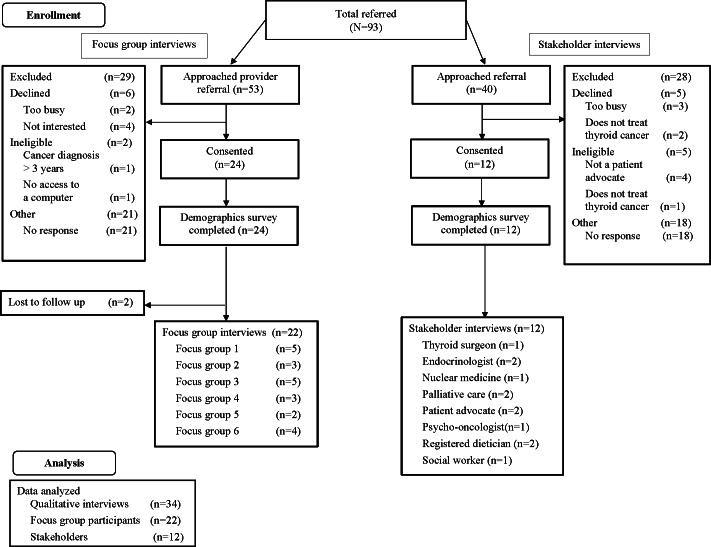
Methods: Following the Social Cognitive Theory framework and person-based principles, we conducted six focus groups with 22 patients diagnosed with DTC who completed RAI treatment and individual interviews with 12 stakeholders in DTC care. The interviews focused on participants' perspectives on current self-management strategies and mockups of a symptom management web-based intervention. Before focus groups and interviews, participants completed a demographics survey. Focus group discussions and interviews were transcribed and coded using content analysis. Interrater reliability was satisfactory (ɑ=.88).
Results: A total of 34 individuals (patients and stakeholders) participated in the study; the mean age was 45 (SD 13.4) and 45.3 (SD 13) years, respectively. Three domains emerged from qualitative interviews: (1) difficult-to-manage RAI symptoms: short, medium, and late treatment effects; (2) key intervention structure and content feedback on mockups; and (3) intervention content to promote RAI symptom management and survivorship care. Focus group participants identified the most prevalent RAI symptoms that were difficult to manage as: dry mouth (11/22, 50%), salivary gland swelling (8/22, 36%), and changes in taste (12/22, 55%). Feedback elicited from both groups found education and symptom management mockup videos to be helpful in patient self-management of RAI symptoms, whereas patients and stakeholders provided mixed feedback on the benefits of a draft frequently asked questions page. Across focus groups and stakeholder interviews, nutrition-based symptom management strategies, communication with family members, and practical survivorship follow-up information emerged as helpful content to include in a future web-based supportive care intervention.
Conclusions: Results suggest education and symptom management videos can empower patients with DTC to self-manage mild to moderate RAI symptoms on a web-based platform. Findings emphasized the need for additional information for patients related to ongoing care following RAI treatment including social support and thyroid cancer surveillance. The findings provide insights for theoretically informed interventions and recommendations for refinements in thyroid cancer survivorship from patient and provider perspectives.




 京公网安备 11010802042870号
京ICP备2023020795号-1
京公网安备 11010802042870号
京ICP备2023020795号-1

 分享
分享
 求助内容:
求助内容: 应助结果提醒方式:
 扫码关注我们
