Antonio Gibran de Almeida Cardoso, Millena Vaz de Carvalho, Maria Isabela Alves de Almeida Silva, Alaiana Marinho Franco, Fernando Rodrigues Peixoto Quaresma, Erika Da Silva Maciel, Marcus Vinicius Nascimento-Ferreira
{"title":"Psychometric properties of the online Satisfaction with Life Scale in university students from a low-income region.","authors":"Antonio Gibran de Almeida Cardoso, Millena Vaz de Carvalho, Maria Isabela Alves de Almeida Silva, Alaiana Marinho Franco, Fernando Rodrigues Peixoto Quaresma, Erika Da Silva Maciel, Marcus Vinicius Nascimento-Ferreira","doi":"10.1186/s41155-023-00254-2","DOIUrl":null,"url":null,"abstract":"<p><strong>Purpose: </strong>To test the feasibility, reliability, and validity of the Satisfaction with Life Scale (SWLS) in an online format in university students from a low-income region.</p><p><strong>Methods: </strong>This was a psychometric study, involving a study of reliability (n = 117) and validity (n = 195) in university students from a region with a Gini index of 0.56. The scale was applied at two time points with an interval of 2 weeks. This scale measures satisfaction with life based on five statements and responses ranging from 1 to 7 (strongly disagree to strongly agree). We conducted the reliability assessment using temporal stability and internal consistency and construct validity assessment by internal structure solution.</p><p><strong>Results: </strong>All SWLS items showed acceptable (rho > 0.30) and significant (p < 0.05) temporal stability and acceptable internal consistency (alpha > 0.70). In construct validity (internal structure), we identified a factor with an explained variance of 59.0% in the exploratory factor analysis. Additionally, in the confirmatory factor analysis, we identified a one-factor structure solution for SWLS with an acceptable model fitting (chi-square/degrees of freedom [X<sup>2</sup>/df] = 6.53; Tucker-Lewis Index [TLI] = 0.991; Comparative Fit Index [CFI] = 0.996; root mean square error of approximation [RMSEA] = 0.040; standardized root mean-squared residual [SRMR] = 0.026).</p><p><strong>Conclusion: </strong>The Satisfaction with Life Scale, in the online format, is a reliable and valid tool for university students in a low-income context.</p>","PeriodicalId":74588,"journal":{"name":"","volume":"36 1","pages":"12"},"PeriodicalIF":0.0,"publicationDate":"2023-05-17","publicationTypes":"Journal Article","fieldsOfStudy":null,"isOpenAccess":false,"openAccessPdf":"https://www.ncbi.nlm.nih.gov/pmc/articles/PMC10189206/pdf/","citationCount":"0","resultStr":null,"platform":"Semanticscholar","paperid":null,"PeriodicalName":"","FirstCategoryId":"102","ListUrlMain":"https://doi.org/10.1186/s41155-023-00254-2","RegionNum":0,"RegionCategory":null,"ArticlePicture":[],"TitleCN":null,"AbstractTextCN":null,"PMCID":null,"EPubDate":"","PubModel":"","JCR":"","JCRName":"","Score":null,"Total":0}
引用次数: 0
Abstract
Purpose: To test the feasibility, reliability, and validity of the Satisfaction with Life Scale (SWLS) in an online format in university students from a low-income region.
Methods: This was a psychometric study, involving a study of reliability (n = 117) and validity (n = 195) in university students from a region with a Gini index of 0.56. The scale was applied at two time points with an interval of 2 weeks. This scale measures satisfaction with life based on five statements and responses ranging from 1 to 7 (strongly disagree to strongly agree). We conducted the reliability assessment using temporal stability and internal consistency and construct validity assessment by internal structure solution.
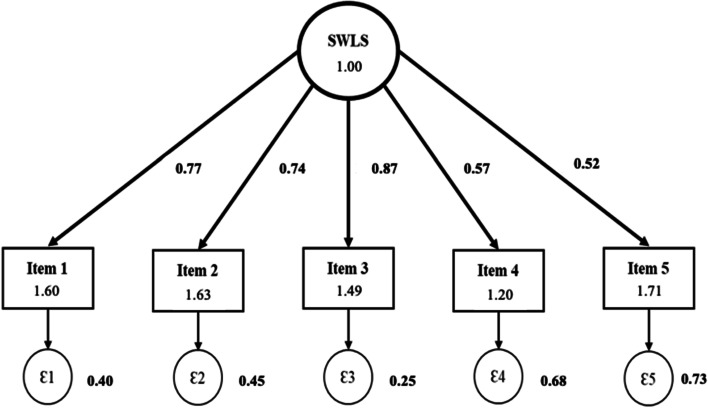
Results: All SWLS items showed acceptable (rho > 0.30) and significant (p < 0.05) temporal stability and acceptable internal consistency (alpha > 0.70). In construct validity (internal structure), we identified a factor with an explained variance of 59.0% in the exploratory factor analysis. Additionally, in the confirmatory factor analysis, we identified a one-factor structure solution for SWLS with an acceptable model fitting (chi-square/degrees of freedom [X2/df] = 6.53; Tucker-Lewis Index [TLI] = 0.991; Comparative Fit Index [CFI] = 0.996; root mean square error of approximation [RMSEA] = 0.040; standardized root mean-squared residual [SRMR] = 0.026).
Conclusion: The Satisfaction with Life Scale, in the online format, is a reliable and valid tool for university students in a low-income context.



 京公网安备 11010802042870号
京ICP备2023020795号-1
京公网安备 11010802042870号
京ICP备2023020795号-1

 分享
分享
 求助内容:
求助内容: 应助结果提醒方式:
 扫码关注我们
