{"title":"Dual Fe/I Single-Atom Electrocatalyst for High-Performance Oxygen Reduction and Wide-Temperature Quasi-Solid-State Zn-Air Batteries","authors":"Meng Du, Bingxian Chu, Qichen Wang, Cheng Li, Yu Lu, Zhan Zhang, Xin Xiao, Cong-Qiao Xu, Meng Gu, Jun Li, Huan Pang, Qiang Xu","doi":"10.1002/adma.202412978","DOIUrl":null,"url":null,"abstract":"<p>Oxygen reduction reaction (ORR) electrocatalysts are essential for widespread application of quasi-solid-state Zn-air batteries (ZABs), but the well-known Fe-N-C single-atom catalysts (SACs) suffer from low activity and stability because of unfavorable strong adsorption of oxygenated intermediates. Herein, the study synthesizes dual Fe/I single atoms anchored on N-doped carbon nanorods (Fe/I-N-CR) via a metal–organic framework (MOF)-mediated two-step tandem-pyrolysis method. Atomic-level I doping modulates the electronic structure of Fe-N<sub>x</sub> centers via the long-range electron delocalization effect. Benefitting from the synergistic effect of dual Fe/I single-atom sites and the structural merits of 1D nanorods, the Fe/I-N-CR catalyst shows excellent ORR activity and stability, superior to Pt/C and Fe or I SACs. When the Fe/I-N-CR is employed as cathode for quasi-solid-state ZABs, a high power density of 197.9 mW cm<sup>−2</sup> and an ultralong cycling lifespan of 280 h at 20 mA cm<sup>−2</sup> are both achieved, greatly exceeding those of commercial Pt/C+IrO<sub>2</sub> (119.1 mW cm<sup>−2</sup> and 47 h). In addition, wide-temperature adaptability and superior stability from −40 to 60 °C are realized for the Fe/I-N-CR-based quasi-solid-state ZABs. This work provides a MOF-mediated two-step tandem-pyrolysis strategy to engineer high-performance dual SACs with metal/nonmetal centers for ORR and sustainable ZABs.</p>","PeriodicalId":114,"journal":{"name":"Advanced Materials","volume":"36 47","pages":""},"PeriodicalIF":26.8000,"publicationDate":"2024-10-10","publicationTypes":"Journal Article","fieldsOfStudy":null,"isOpenAccess":false,"openAccessPdf":"","citationCount":"0","resultStr":null,"platform":"Semanticscholar","paperid":null,"PeriodicalName":"Advanced Materials","FirstCategoryId":"88","ListUrlMain":"https://advanced.onlinelibrary.wiley.com/doi/10.1002/adma.202412978","RegionNum":1,"RegionCategory":"材料科学","ArticlePicture":[],"TitleCN":null,"AbstractTextCN":null,"PMCID":null,"EPubDate":"","PubModel":"","JCR":"Q1","JCRName":"CHEMISTRY, MULTIDISCIPLINARY","Score":null,"Total":0}
引用次数: 0
Abstract
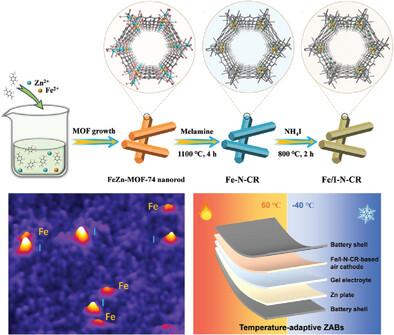
Oxygen reduction reaction (ORR) electrocatalysts are essential for widespread application of quasi-solid-state Zn-air batteries (ZABs), but the well-known Fe-N-C single-atom catalysts (SACs) suffer from low activity and stability because of unfavorable strong adsorption of oxygenated intermediates. Herein, the study synthesizes dual Fe/I single atoms anchored on N-doped carbon nanorods (Fe/I-N-CR) via a metal–organic framework (MOF)-mediated two-step tandem-pyrolysis method. Atomic-level I doping modulates the electronic structure of Fe-Nx centers via the long-range electron delocalization effect. Benefitting from the synergistic effect of dual Fe/I single-atom sites and the structural merits of 1D nanorods, the Fe/I-N-CR catalyst shows excellent ORR activity and stability, superior to Pt/C and Fe or I SACs. When the Fe/I-N-CR is employed as cathode for quasi-solid-state ZABs, a high power density of 197.9 mW cm−2 and an ultralong cycling lifespan of 280 h at 20 mA cm−2 are both achieved, greatly exceeding those of commercial Pt/C+IrO2 (119.1 mW cm−2 and 47 h). In addition, wide-temperature adaptability and superior stability from −40 to 60 °C are realized for the Fe/I-N-CR-based quasi-solid-state ZABs. This work provides a MOF-mediated two-step tandem-pyrolysis strategy to engineer high-performance dual SACs with metal/nonmetal centers for ORR and sustainable ZABs.
期刊介绍:
Advanced Materials, one of the world's most prestigious journals and the foundation of the Advanced portfolio, is the home of choice for best-in-class materials science for more than 30 years. Following this fast-growing and interdisciplinary field, we are considering and publishing the most important discoveries on any and all materials from materials scientists, chemists, physicists, engineers as well as health and life scientists and bringing you the latest results and trends in modern materials-related research every week.





 京公网安备 11010802042870号
京ICP备2023020795号-1
京公网安备 11010802042870号
京ICP备2023020795号-1

 分享
分享
 求助内容:
求助内容: 应助结果提醒方式:
 扫码关注我们
