Yining Zhang, Jiameng Yu, Hongsheng Shi, Shuanghong Wang, Yinjie Lv, Yue Zhang, Qiong Yuan, Jinjiang Liang, Tianyi Gao, Ran Wei, Xin Chen, Luyao Wang, Yi Yu, Wei Liu
{"title":"Fiber-Reinforced Ultrathin Solid Polymer Electrolyte for Solid-State Lithium-Metal Batteries","authors":"Yining Zhang, Jiameng Yu, Hongsheng Shi, Shuanghong Wang, Yinjie Lv, Yue Zhang, Qiong Yuan, Jinjiang Liang, Tianyi Gao, Ran Wei, Xin Chen, Luyao Wang, Yi Yu, Wei Liu","doi":"10.1002/adfm.202421054","DOIUrl":null,"url":null,"abstract":"<p>Reducing the thickness of solid polymer electrolytes can help to enhance the energy density for solid-state batteries. However, ultrathin electrolytes still face difficulties in preparation methods, mechanical properties, and interface instability. Herein, a free-standing, scalable, and ultrathin solid polymer electrolyte with a thickness of 10 µm is reported. It is achieved through in situ thermal curing after filling a porous electrospun polyacrylonitrile fiber membrane with poly(ethylene glycol) diacrylate-based electrolyte. Impressively, it contributes to a high ionic conductivity of 8.8 × 10<sup>−4</sup> S cm<sup>−1</sup> at room temperature. The membrane can not only provide good mechanical strength but also offer a Li<sub>3</sub>N-enriched solid electrolyte interphase, thereby stabilizing the lithium metal anode. The pouch cell pairing the ultrathin electrolyte with Li foil and LiNi<sub>0.8</sub>Co<sub>0.1</sub>Mn<sub>0.1</sub>O<sub>2</sub> cathode of high mass loading can realize a gravimetric/volumetric energy density of 380 Wh kg<sup>−1</sup> and 936 Wh L<sup>−1</sup>. This investigation provides new insights into the potential of fiber-reinforced membranes for high-performance solid-state batteries.</p>","PeriodicalId":112,"journal":{"name":"Advanced Functional Materials","volume":"35 25","pages":""},"PeriodicalIF":19.0000,"publicationDate":"2025-01-29","publicationTypes":"Journal Article","fieldsOfStudy":null,"isOpenAccess":false,"openAccessPdf":"","citationCount":"0","resultStr":null,"platform":"Semanticscholar","paperid":null,"PeriodicalName":"Advanced Functional Materials","FirstCategoryId":"88","ListUrlMain":"https://advanced.onlinelibrary.wiley.com/doi/10.1002/adfm.202421054","RegionNum":1,"RegionCategory":"材料科学","ArticlePicture":[],"TitleCN":null,"AbstractTextCN":null,"PMCID":null,"EPubDate":"","PubModel":"","JCR":"Q1","JCRName":"CHEMISTRY, MULTIDISCIPLINARY","Score":null,"Total":0}
引用次数: 0
Abstract
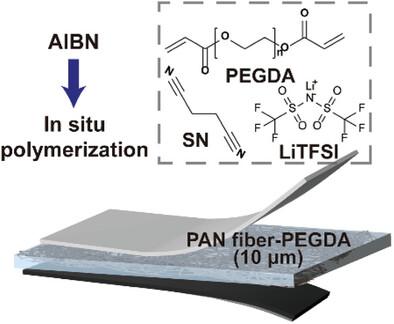
Reducing the thickness of solid polymer electrolytes can help to enhance the energy density for solid-state batteries. However, ultrathin electrolytes still face difficulties in preparation methods, mechanical properties, and interface instability. Herein, a free-standing, scalable, and ultrathin solid polymer electrolyte with a thickness of 10 µm is reported. It is achieved through in situ thermal curing after filling a porous electrospun polyacrylonitrile fiber membrane with poly(ethylene glycol) diacrylate-based electrolyte. Impressively, it contributes to a high ionic conductivity of 8.8 × 10⁻⁴ S cm−1 at room temperature. The membrane can not only provide good mechanical strength but also offer a Li3N-enriched solid electrolyte interphase, thereby stabilizing the lithium metal anode. The pouch cell pairing the ultrathin electrolyte with Li foil and LiNi0.8Co0.1Mn0.1O2 cathode of high mass loading can realize a gravimetric/volumetric energy density of 380 Wh kg−1 and 936 Wh L−1. This investigation provides new insights into the potential of fiber-reinforced membranes for high-performance solid-state batteries.
期刊介绍:
Firmly established as a top-tier materials science journal, Advanced Functional Materials reports breakthrough research in all aspects of materials science, including nanotechnology, chemistry, physics, and biology every week.
Advanced Functional Materials is known for its rapid and fair peer review, quality content, and high impact, making it the first choice of the international materials science community.





 京公网安备 11010802042870号
京ICP备2023020795号-1
京公网安备 11010802042870号
京ICP备2023020795号-1

 分享
分享
 求助内容:
求助内容: 应助结果提醒方式:
 扫码关注我们
