{"title":"The Origin of Li2S2 Reduction Mechanism Modulated by Single-Atom Catalyst for all Solid-State Li-S Batteries","authors":"Miao He, Yuxing Fan, Shen Liu, Shuying Wang, Tongwei Wu, Dongjiang Chen, Anjun Hu, Chaoyi Yan, Yichao Yan, Jianping Long, Yin Hu, Tianyu Lei, Peng Li, Wei Chen","doi":"10.1002/aenm.202405642","DOIUrl":null,"url":null,"abstract":"<p>All solid-state lithium-sulfur batteries (ASSLSBs) demonstrate tremendous potential in the next-generation energy storage system. Nevertheless, the incomplete conversion of Li<sub>2</sub>S<sub>2</sub> to Li<sub>2</sub>S within the sulfur electrode imposes a substantial impediment on the capacity release. Herein, the nickel single-atom catalyst (NiNC) materials are employed to ameliorate the sluggish reaction kinetics of polysulfides. Moreover, the unknown origin of the catalytic activity of NiNC materials on the ASSLSBs is revealed by using the ligand-field theory. The results show that the <span></span><math>\n <semantics>\n <msub>\n <mi>d</mi>\n <msup>\n <mi>z</mi>\n <mn>2</mn>\n </msup>\n </msub>\n <annotation>${d_{{z^2}}}$</annotation>\n </semantics></math> orbital of Ni exhibits a significant vertical hybridization phenomenon from the inert dsp<sup>2</sup> hybridization state to the active d<sup>2</sup>sp<sup>3</sup> hybridization state, which exerts a catalytic effect on the reduction of Li<sub>2</sub>S<sub>2</sub> to Li<sub>2</sub>S. As a result, the assembled ASSLSBs attain a capacity release of 1506.9 mAh g<sup>−1</sup> at 0.05 C and more than 70% retention ratio after 600 cycles at a high rate of 2 C. The in-depth study of the <i>d</i>-orbitals of nickel single-atom catalysts in this work offers deep insights into the relationship between the catalytic substrate and active substance and a novel perspective for the realization of ASSLSB with high energy density.</p>","PeriodicalId":111,"journal":{"name":"Advanced Energy Materials","volume":"15 19","pages":""},"PeriodicalIF":26.0000,"publicationDate":"2025-02-10","publicationTypes":"Journal Article","fieldsOfStudy":null,"isOpenAccess":false,"openAccessPdf":"","citationCount":"0","resultStr":null,"platform":"Semanticscholar","paperid":null,"PeriodicalName":"Advanced Energy Materials","FirstCategoryId":"88","ListUrlMain":"https://advanced.onlinelibrary.wiley.com/doi/10.1002/aenm.202405642","RegionNum":1,"RegionCategory":"材料科学","ArticlePicture":[],"TitleCN":null,"AbstractTextCN":null,"PMCID":null,"EPubDate":"","PubModel":"","JCR":"Q1","JCRName":"CHEMISTRY, PHYSICAL","Score":null,"Total":0}
引用次数: 0
Abstract
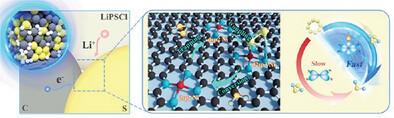
All solid-state lithium-sulfur batteries (ASSLSBs) demonstrate tremendous potential in the next-generation energy storage system. Nevertheless, the incomplete conversion of Li2S2 to Li2S within the sulfur electrode imposes a substantial impediment on the capacity release. Herein, the nickel single-atom catalyst (NiNC) materials are employed to ameliorate the sluggish reaction kinetics of polysulfides. Moreover, the unknown origin of the catalytic activity of NiNC materials on the ASSLSBs is revealed by using the ligand-field theory. The results show that the orbital of Ni exhibits a significant vertical hybridization phenomenon from the inert dsp2 hybridization state to the active d2sp3 hybridization state, which exerts a catalytic effect on the reduction of Li2S2 to Li2S. As a result, the assembled ASSLSBs attain a capacity release of 1506.9 mAh g−1 at 0.05 C and more than 70% retention ratio after 600 cycles at a high rate of 2 C. The in-depth study of the d-orbitals of nickel single-atom catalysts in this work offers deep insights into the relationship between the catalytic substrate and active substance and a novel perspective for the realization of ASSLSB with high energy density.
全固态锂硫电池(ASSLSBs)在下一代储能系统中显示出巨大的潜力。然而,硫电极内Li2S2到Li2S的不完全转化对容量释放造成了很大的阻碍。本文采用镍单原子催化剂(NiNC)材料来改善多硫化物缓慢的反应动力学。此外,利用配体场理论揭示了NiNC材料在ASSLSBs上催化活性的未知来源。结果表明:Ni的dz2${d_{{z^2}}}$轨道呈现明显的垂直杂化现象,由惰性d2sp2杂化态向活性d2sp3杂化态转变,对Li2S2还原为Li2S起到了催化作用。结果表明,组装的ASSLSB在0.05℃下的容量释放达到1506.9 mAh g−1,在2℃的高速率下,经过600次循环后的保留率超过70%。本工作对镍单原子催化剂d轨道的深入研究,为深入了解催化底物与活性物质之间的关系提供了深刻的见解,为实现高能量密度的ASSLSB提供了新的视角。
期刊介绍:
Established in 2011, Advanced Energy Materials is an international, interdisciplinary, English-language journal that focuses on materials used in energy harvesting, conversion, and storage. It is regarded as a top-quality journal alongside Advanced Materials, Advanced Functional Materials, and Small.
With a 2022 Impact Factor of 27.8, Advanced Energy Materials is considered a prime source for the best energy-related research. The journal covers a wide range of topics in energy-related research, including organic and inorganic photovoltaics, batteries and supercapacitors, fuel cells, hydrogen generation and storage, thermoelectrics, water splitting and photocatalysis, solar fuels and thermosolar power, magnetocalorics, and piezoelectronics.
The readership of Advanced Energy Materials includes materials scientists, chemists, physicists, and engineers in both academia and industry. The journal is indexed in various databases and collections, such as Advanced Technologies & Aerospace Database, FIZ Karlsruhe, INSPEC (IET), Science Citation Index Expanded, Technology Collection, and Web of Science, among others.



 京公网安备 11010802042870号
京ICP备2023020795号-1
京公网安备 11010802042870号
京ICP备2023020795号-1

 分享
分享
 求助内容:
求助内容: 应助结果提醒方式:
 扫码关注我们
