Yawen Li, Jialun Yu, Jiangtao Li, Yusheng Wang, Baoquan Sun
{"title":"Critical Factors and Equilibrium Analysis of Luminescent Down-Shifting Process for Silicon Heterojunction Solar Cells","authors":"Yawen Li, Jialun Yu, Jiangtao Li, Yusheng Wang, Baoquan Sun","doi":"10.1002/aenm.202405918","DOIUrl":null,"url":null,"abstract":"<p>Utilizing photoluminescent quantum dots (QDs) as a luminescent down-shifting (LDS) layer to convert high-energy photons into lower-energy ones is a prominent approach to reducing parasitic absorption of silicon heterojunction (SHJ) solar cells. Here, a ray-optic model is presented to gain insight into light conversion contribution on the short-circuit current density (<i>J<sub>sc</sub></i>) of the SHJ solar cell with an LDS layer. The correlation reveals that the primary factors impacting external quantum efficiency (EQE) are the absorption coefficient at short wavelengths and the photoluminescence quantum yield (PLQY) of the LDS layer. Notably, PLQY is dominant in determining the contribution to the device efficiency if the LDS layer can harvest all the parasitic light, particularly when there is no surface reflectance change. Furthermore, the EQE spectrum of high-efficiency SHJ solar cells is experimentally investigated with the QDs LDS layer to validate the model, revealing that it aligns well with the experiment results. Employing a MgF<sub>2</sub>/QDs LDS layer, the <i>J<sub>sc</sub></i> with 0.50 mA cm<sup>−</sup><sup>2</sup> is enhanced, yielding the SHJ solar cells with an efficiency of over 22.3%. The work develops a broadly applicable model that aids in screening suitable photoluminescent materials for LDS layer applications in photovoltaic devices and elucidates the theoretical contributions to EQE.</p>","PeriodicalId":111,"journal":{"name":"Advanced Energy Materials","volume":"15 24","pages":""},"PeriodicalIF":26.0000,"publicationDate":"2025-02-25","publicationTypes":"Journal Article","fieldsOfStudy":null,"isOpenAccess":false,"openAccessPdf":"","citationCount":"0","resultStr":null,"platform":"Semanticscholar","paperid":null,"PeriodicalName":"Advanced Energy Materials","FirstCategoryId":"88","ListUrlMain":"https://advanced.onlinelibrary.wiley.com/doi/10.1002/aenm.202405918","RegionNum":1,"RegionCategory":"材料科学","ArticlePicture":[],"TitleCN":null,"AbstractTextCN":null,"PMCID":null,"EPubDate":"","PubModel":"","JCR":"Q1","JCRName":"CHEMISTRY, PHYSICAL","Score":null,"Total":0}
引用次数: 0
Abstract
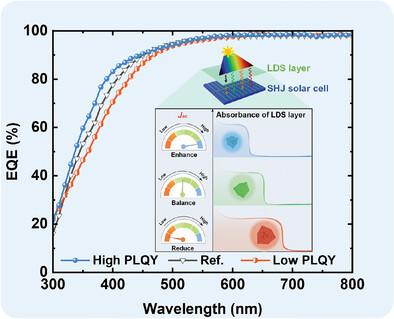
Utilizing photoluminescent quantum dots (QDs) as a luminescent down-shifting (LDS) layer to convert high-energy photons into lower-energy ones is a prominent approach to reducing parasitic absorption of silicon heterojunction (SHJ) solar cells. Here, a ray-optic model is presented to gain insight into light conversion contribution on the short-circuit current density (Jsc) of the SHJ solar cell with an LDS layer. The correlation reveals that the primary factors impacting external quantum efficiency (EQE) are the absorption coefficient at short wavelengths and the photoluminescence quantum yield (PLQY) of the LDS layer. Notably, PLQY is dominant in determining the contribution to the device efficiency if the LDS layer can harvest all the parasitic light, particularly when there is no surface reflectance change. Furthermore, the EQE spectrum of high-efficiency SHJ solar cells is experimentally investigated with the QDs LDS layer to validate the model, revealing that it aligns well with the experiment results. Employing a MgF2/QDs LDS layer, the Jsc with 0.50 mA cm−2 is enhanced, yielding the SHJ solar cells with an efficiency of over 22.3%. The work develops a broadly applicable model that aids in screening suitable photoluminescent materials for LDS layer applications in photovoltaic devices and elucidates the theoretical contributions to EQE.
利用光致发光量子点(QDs)作为发光降移(LDS)层将高能光子转换为低能光子是减少硅异质结(SHJ)太阳能电池寄生吸收的重要途径。本文提出了一种射线光学模型,以深入了解光转换对具有LDS层的SHJ太阳能电池短路电流密度(Jsc)的贡献。相关分析表明,影响外量子效率的主要因素是LDS层的短波吸收系数和光致发光量子产率(PLQY)。值得注意的是,如果LDS层可以收集所有寄生光,特别是在没有表面反射率变化的情况下,PLQY在决定器件效率的贡献方面占主导地位。此外,利用QDs LDS层对高效SHJ太阳能电池的EQE光谱进行了实验研究,验证了模型的正确性,结果表明该模型与实验结果吻合较好。采用MgF2/QDs LDS层,增强了0.50 mA cm−2的Jsc,得到了效率超过22.3%的SHJ太阳能电池。该工作开发了一个广泛适用的模型,有助于筛选适合光伏器件中LDS层应用的光致发光材料,并阐明了对EQE的理论贡献。
期刊介绍:
Established in 2011, Advanced Energy Materials is an international, interdisciplinary, English-language journal that focuses on materials used in energy harvesting, conversion, and storage. It is regarded as a top-quality journal alongside Advanced Materials, Advanced Functional Materials, and Small.
With a 2022 Impact Factor of 27.8, Advanced Energy Materials is considered a prime source for the best energy-related research. The journal covers a wide range of topics in energy-related research, including organic and inorganic photovoltaics, batteries and supercapacitors, fuel cells, hydrogen generation and storage, thermoelectrics, water splitting and photocatalysis, solar fuels and thermosolar power, magnetocalorics, and piezoelectronics.
The readership of Advanced Energy Materials includes materials scientists, chemists, physicists, and engineers in both academia and industry. The journal is indexed in various databases and collections, such as Advanced Technologies & Aerospace Database, FIZ Karlsruhe, INSPEC (IET), Science Citation Index Expanded, Technology Collection, and Web of Science, among others.







 京公网安备 11010802042870号
京ICP备2023020795号-1
京公网安备 11010802042870号
京ICP备2023020795号-1

 分享
分享
 求助内容:
求助内容: 应助结果提醒方式:
 扫码关注我们
