Bowen Liu, Tengfei Song, Lin Chen, Ashwin T. Shekhar, Marta Mirolo, Valentin Vinci, Jakub Drnec, Joel Cornelio, Dongrui Xie, Elizabeth H. Driscoll, Peter R. Slater, Emma Kendrick
{"title":"Sustainable Recovery and Reuse of Hard Carbon From Scrap and End-of-Life Sodium-Ion Batteries","authors":"Bowen Liu, Tengfei Song, Lin Chen, Ashwin T. Shekhar, Marta Mirolo, Valentin Vinci, Jakub Drnec, Joel Cornelio, Dongrui Xie, Elizabeth H. Driscoll, Peter R. Slater, Emma Kendrick","doi":"10.1002/aenm.202405894","DOIUrl":null,"url":null,"abstract":"<p>As Sodium-ion battery (SIB) technology progresses toward commercial viability, sustainable end-of-life (EOL) management is critical. Methods for recycling key components such as hard carbon (HC), a negative electrode material, remain underexplored. This study introduces a direct and efficient recycling approach for HC from production scrap and EOL cells using “ice-stripping” followed by a low-temperature binder negation at 300 °C under nitrogen. The effects of temperature on HC structural integrity and electrochemical performance are comprehensively characterized using XRD, Wide-Angle X-ray Scattering (WAXS), and XPS. Heating above 400 °C induces irreversible damage to HC's graphene layers and modifies the carbon surfaces, resulting in poor electrochemical performance. However, HC reclaimed at 300 °C retains near-pristine electrochemical performance, with capacities of 243 mAh g⁻¹ (scrap) and 228 mAh g⁻¹ (EOL) after 50 cycles. Full-cell configurations demonstrates robust cycling stability, with 86% and 89% capacity retention after 200 cycles for HC derived from scrap and EOL cells, respectively. This work highlights the potential of lower-temperature, direct recycling to enable a circular economy for SIBs. The findings set a benchmark for developing sustainable recycling methods for HC and other SIB components.</p>","PeriodicalId":111,"journal":{"name":"Advanced Energy Materials","volume":"15 46","pages":""},"PeriodicalIF":26.0000,"publicationDate":"2025-02-25","publicationTypes":"Journal Article","fieldsOfStudy":null,"isOpenAccess":false,"openAccessPdf":"https://advanced.onlinelibrary.wiley.com/doi/epdf/10.1002/aenm.202405894","citationCount":"0","resultStr":null,"platform":"Semanticscholar","paperid":null,"PeriodicalName":"Advanced Energy Materials","FirstCategoryId":"88","ListUrlMain":"https://advanced.onlinelibrary.wiley.com/doi/10.1002/aenm.202405894","RegionNum":1,"RegionCategory":"材料科学","ArticlePicture":[],"TitleCN":null,"AbstractTextCN":null,"PMCID":null,"EPubDate":"","PubModel":"","JCR":"Q1","JCRName":"CHEMISTRY, PHYSICAL","Score":null,"Total":0}
引用次数: 0
Abstract
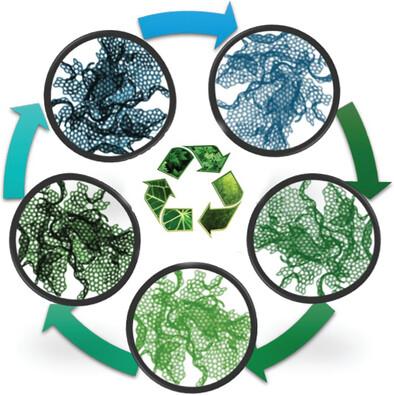
As Sodium-ion battery (SIB) technology progresses toward commercial viability, sustainable end-of-life (EOL) management is critical. Methods for recycling key components such as hard carbon (HC), a negative electrode material, remain underexplored. This study introduces a direct and efficient recycling approach for HC from production scrap and EOL cells using “ice-stripping” followed by a low-temperature binder negation at 300 °C under nitrogen. The effects of temperature on HC structural integrity and electrochemical performance are comprehensively characterized using XRD, Wide-Angle X-ray Scattering (WAXS), and XPS. Heating above 400 °C induces irreversible damage to HC's graphene layers and modifies the carbon surfaces, resulting in poor electrochemical performance. However, HC reclaimed at 300 °C retains near-pristine electrochemical performance, with capacities of 243 mAh g⁻¹ (scrap) and 228 mAh g⁻¹ (EOL) after 50 cycles. Full-cell configurations demonstrates robust cycling stability, with 86% and 89% capacity retention after 200 cycles for HC derived from scrap and EOL cells, respectively. This work highlights the potential of lower-temperature, direct recycling to enable a circular economy for SIBs. The findings set a benchmark for developing sustainable recycling methods for HC and other SIB components.
随着钠离子电池(SIB)技术向商业可行性发展,可持续的寿命终止(EOL)管理至关重要。回收诸如硬碳(HC),一种负极材料等关键部件的方法仍未得到充分探索。本研究介绍了一种直接有效的回收方法,利用“冰剥离”,然后在300°C的氮气下进行低温粘结剂消极性。利用XRD、广角x射线散射(WAXS)和XPS综合表征了温度对HC结构完整性和电化学性能的影响。加热超过400°C会对HC的石墨烯层造成不可逆的损伤,并改变碳表面,导致电化学性能差。然而,在300°C回收的HC保持了近乎原始的电化学性能,循环50次后的容量为243 mAh g⁻¹(废料)和228 mAh g⁻¹(EOL)。全电池结构表现出强大的循环稳定性,在200次循环后,废旧电池和EOL电池的HC容量分别保持86%和89%。这项工作强调了低温直接回收的潜力,使sib能够实现循环经济。研究结果为开发HC和其他SIB组件的可持续回收方法设定了基准。
期刊介绍:
Established in 2011, Advanced Energy Materials is an international, interdisciplinary, English-language journal that focuses on materials used in energy harvesting, conversion, and storage. It is regarded as a top-quality journal alongside Advanced Materials, Advanced Functional Materials, and Small.
With a 2022 Impact Factor of 27.8, Advanced Energy Materials is considered a prime source for the best energy-related research. The journal covers a wide range of topics in energy-related research, including organic and inorganic photovoltaics, batteries and supercapacitors, fuel cells, hydrogen generation and storage, thermoelectrics, water splitting and photocatalysis, solar fuels and thermosolar power, magnetocalorics, and piezoelectronics.
The readership of Advanced Energy Materials includes materials scientists, chemists, physicists, and engineers in both academia and industry. The journal is indexed in various databases and collections, such as Advanced Technologies & Aerospace Database, FIZ Karlsruhe, INSPEC (IET), Science Citation Index Expanded, Technology Collection, and Web of Science, among others.




 京公网安备 11010802042870号
京ICP备2023020795号-1
京公网安备 11010802042870号
京ICP备2023020795号-1

 分享
分享
 求助内容:
求助内容: 应助结果提醒方式:
 扫码关注我们
