Jennifer M. Jones , Gian Maria Niccolò Benucci , Sarah E. Evans
{"title":"Drought increases microbial allocation to stress tolerance but with few tradeoffs among community-level traits","authors":"Jennifer M. Jones , Gian Maria Niccolò Benucci , Sarah E. Evans","doi":"10.1016/j.soilbio.2025.109787","DOIUrl":null,"url":null,"abstract":"<div><div>Climate change will increase soil drying, altering microbial communities via increasing water stress and decreasing resource availability. The responses of these microbial communities to changing environments could be governed by physiological tradeoffs between high yield, resource acquisition, and stress tolerance (YAS framework). We leveraged a unique field experiment that manipulates both drought and carbon availability across two years and three land uses, and we measured both physiological (with bioassays) and genetic (with metagenomics) microbial traits at the community level to test the following hypotheses: 1. Drought increases microbial allocation to stress tolerance functions, at both physiological and genetic levels. 2. Because microbes are resource-limited under drought, increased carbon will enable greater expression of stress tolerance. 3. All three key life history traits described in the YAS framework will trade off. Drought did increase microbial physiological investment in stress tolerance (measured via trehalose production), but we saw few other changes in microbial communities under drought. Adding carbon to plots increased resource acquisition (measured via enzyme activity and resource acquisition gene abundance) and stress tolerance (trehalose assay), but did so in both drought and average rainfall environments. We found little evidence of trait tradeoffs, as a negative correlation between rRNA copy number and resource acquisition gene abundance was the only significant negative correlation between traits that we found that was consistent across years (for physiological or genetic traits). In summary, we found C addition, and to a lesser extent, drought, altered microbial community function and functional genes. However, resources did not alter drought response in a way that was consistent with theory of life history tradeoffs.</div></div>","PeriodicalId":21888,"journal":{"name":"Soil Biology & Biochemistry","volume":"205 ","pages":"Article 109787"},"PeriodicalIF":10.3000,"publicationDate":"2025-06-01","publicationTypes":"Journal Article","fieldsOfStudy":null,"isOpenAccess":false,"openAccessPdf":"","citationCount":"0","resultStr":null,"platform":"Semanticscholar","paperid":null,"PeriodicalName":"Soil Biology & Biochemistry","FirstCategoryId":"97","ListUrlMain":"https://www.sciencedirect.com/science/article/pii/S003807172500080X","RegionNum":1,"RegionCategory":"农林科学","ArticlePicture":[],"TitleCN":null,"AbstractTextCN":null,"PMCID":null,"EPubDate":"2025/3/15 0:00:00","PubModel":"Epub","JCR":"Q1","JCRName":"SOIL SCIENCE","Score":null,"Total":0}
引用次数: 0
Abstract
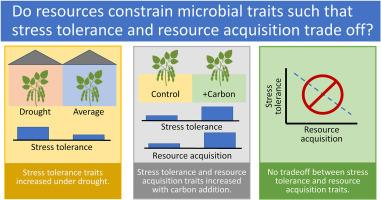
Climate change will increase soil drying, altering microbial communities via increasing water stress and decreasing resource availability. The responses of these microbial communities to changing environments could be governed by physiological tradeoffs between high yield, resource acquisition, and stress tolerance (YAS framework). We leveraged a unique field experiment that manipulates both drought and carbon availability across two years and three land uses, and we measured both physiological (with bioassays) and genetic (with metagenomics) microbial traits at the community level to test the following hypotheses: 1. Drought increases microbial allocation to stress tolerance functions, at both physiological and genetic levels. 2. Because microbes are resource-limited under drought, increased carbon will enable greater expression of stress tolerance. 3. All three key life history traits described in the YAS framework will trade off. Drought did increase microbial physiological investment in stress tolerance (measured via trehalose production), but we saw few other changes in microbial communities under drought. Adding carbon to plots increased resource acquisition (measured via enzyme activity and resource acquisition gene abundance) and stress tolerance (trehalose assay), but did so in both drought and average rainfall environments. We found little evidence of trait tradeoffs, as a negative correlation between rRNA copy number and resource acquisition gene abundance was the only significant negative correlation between traits that we found that was consistent across years (for physiological or genetic traits). In summary, we found C addition, and to a lesser extent, drought, altered microbial community function and functional genes. However, resources did not alter drought response in a way that was consistent with theory of life history tradeoffs.
期刊介绍:
Soil Biology & Biochemistry publishes original research articles of international significance focusing on biological processes in soil and their applications to soil and environmental quality. Major topics include the ecology and biochemical processes of soil organisms, their effects on the environment, and interactions with plants. The journal also welcomes state-of-the-art reviews and discussions on contemporary research in soil biology and biochemistry.




 京公网安备 11010802042870号
京ICP备2023020795号-1
京公网安备 11010802042870号
京ICP备2023020795号-1

 分享
分享
 求助内容:
求助内容: 应助结果提醒方式:
 扫码关注我们
