Manu V.S., Marco Tonelli, Bailey Bell, Alok K. Sharma, Tim S. Bugni and Gianluigi Veglia
{"title":"Detection of 15N-labeled metabolites in microbial extracts using AI-designed broadband pulses for 1H, 15N heteronuclear NMR spectroscopy†","authors":"Manu V.S., Marco Tonelli, Bailey Bell, Alok K. Sharma, Tim S. Bugni and Gianluigi Veglia","doi":"10.1039/D5AN00074B","DOIUrl":null,"url":null,"abstract":"<p >Approximately 40% of bacterial and mammalian metabolites contain nitrogen-based chemical moieties such as amides, amines, and imines. The identification and quantification of these groups <em>via</em> 2D <small><sup>1</sup></small>H,<small><sup>15</sup></small>N heteronuclear NMR spectroscopy have broadened the catalog of NMR-detected metabolites. However, these NMR experiments necessitate broadband radiofrequency (RF) pulses for inversion and refocusing operations to encompass the full range of <small><sup>15</sup></small>N chemical shifts, a challenge that becomes increasingly apparent at high and ultra-high magnetic fields. Here, we show that a newly AI-designed broadband <small><sup>15</sup></small>N universal 180° pulse for both inversion and refocusing incorporated in the 2D <small><sup>1</sup></small>H, <small><sup>15</sup></small>N heteronuclear single quantum coherence (2D <small><sup>1</sup></small>H–<small><sup>15</sup></small>N BB-HSQC) experiment significantly enhances spectral sensitivity. We demonstrate the advantage of the new technique by analyzing the crude extract of <em>Micromonospora</em> sp. WMMC264, a microbial strain that produces siderophores for iron absorption from the environment. The implementation of the AI-designed pulse in the 2D <small><sup>1</sup></small>H–<small><sup>15</sup></small>N BB-HSQC experiment will contribute to advancing the analysis of nitrogen-containing metabolites in biological fluids and cell extracts.</p>","PeriodicalId":63,"journal":{"name":"Analyst","volume":" 9","pages":" 1856-1861"},"PeriodicalIF":3.3000,"publicationDate":"2025-03-20","publicationTypes":"Journal Article","fieldsOfStudy":null,"isOpenAccess":false,"openAccessPdf":"","citationCount":"0","resultStr":null,"platform":"Semanticscholar","paperid":null,"PeriodicalName":"Analyst","FirstCategoryId":"92","ListUrlMain":"https://pubs.rsc.org/en/content/articlelanding/2025/an/d5an00074b","RegionNum":3,"RegionCategory":"化学","ArticlePicture":[],"TitleCN":null,"AbstractTextCN":null,"PMCID":null,"EPubDate":"","PubModel":"","JCR":"Q2","JCRName":"CHEMISTRY, ANALYTICAL","Score":null,"Total":0}
引用次数: 0
Abstract
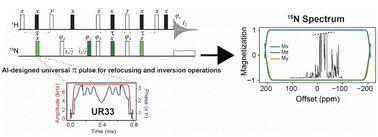
Approximately 40% of bacterial and mammalian metabolites contain nitrogen-based chemical moieties such as amides, amines, and imines. The identification and quantification of these groups via 2D 1H,15N heteronuclear NMR spectroscopy have broadened the catalog of NMR-detected metabolites. However, these NMR experiments necessitate broadband radiofrequency (RF) pulses for inversion and refocusing operations to encompass the full range of 15N chemical shifts, a challenge that becomes increasingly apparent at high and ultra-high magnetic fields. Here, we show that a newly AI-designed broadband 15N universal 180° pulse for both inversion and refocusing incorporated in the 2D 1H, 15N heteronuclear single quantum coherence (2D 1H–15N BB-HSQC) experiment significantly enhances spectral sensitivity. We demonstrate the advantage of the new technique by analyzing the crude extract of Micromonospora sp. WMMC264, a microbial strain that produces siderophores for iron absorption from the environment. The implementation of the AI-designed pulse in the 2D 1H–15N BB-HSQC experiment will contribute to advancing the analysis of nitrogen-containing metabolites in biological fluids and cell extracts.



 京公网安备 11010802042870号
京ICP备2023020795号-1
京公网安备 11010802042870号
京ICP备2023020795号-1

 分享
分享
 求助内容:
求助内容: 应助结果提醒方式:
 扫码关注我们
