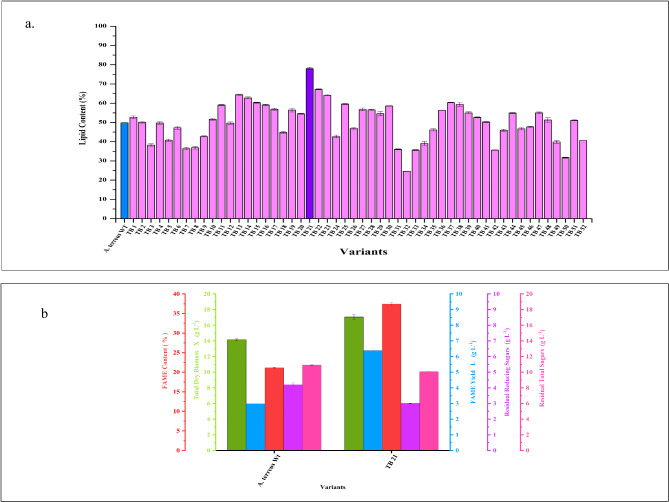
{"title":"Aspergillus terreus variant TB21 wet biomass optimized by in-situ transesterification for biodiesel production.","authors":"Rashmi K Bed, V Ravi Kumar, Ameeta RaviKumar","doi":"10.1186/s13568-024-01772-7","DOIUrl":null,"url":null,"abstract":"<p><p>The oleaginous fungus, Aspergillus terreus when subjected to random chemical mutagenesis led to isolation of TB21 variant with improved lipid content (78.1%) as compared to wild type (49.8%). The fungal wet biomass grown on sugarcane bagasse hydrolysate (SCBH) was subjected to one-step in-situ (direct) acid transesterification to optimize its conversion to biodiesel using a 2-level factorial statistical design of experiments. The process optimization revealed that wet biomass and methanol were the most significant factors and in a short reaction time period of 5 min with low methanol: wet biomass ratio (10:1) influenced FAME production Statistical optimization studies showed that TB21 exhibited a higher FAME content of 76.5 and 38.1% (w/w) from wet and dry biomass, respectively when compared to wild type (48.1 and 24.5%). FAME productivity (0.55<sup>-1</sup> h<sup>-1</sup>) and a yield (66 gL<sup>-1</sup>) were achieved when TB21 was grown on SCBH for 120 h at 30 °C. The FAME profile from the wet biomass of TB21 grown on SCBH had desirable amounts of saturated (77.7%), monounsaturated (7.2%), and polyunsaturated (2.4%) methyl esters. Physico-chemical properties of TB21-derived biodiesel were determined, namely, density(0.88 g cm<sup>-3</sup>), kinematic viscosity (4.1 mm s<sup>-2</sup>), iodine value (96.82), cetane number (55.31), free fatty acid content (0.15%), total acid number (0.3 NaOH mg g<sup>-1</sup>), meeting international (ASTM D6751, EN 14214) and Indian (IS 15607) standards. Thus, the direct one-pot in situ transesterification reaction using wet biomass of variant TB21 strain showed improved production and quality of biodiesel with potential large scale application using the low-cost substrate (SCBH).</p>","PeriodicalId":7537,"journal":{"name":"AMB Express","volume":"15 1","pages":"23"},"PeriodicalIF":3.7000,"publicationDate":"2025-02-07","publicationTypes":"Journal Article","fieldsOfStudy":null,"isOpenAccess":false,"openAccessPdf":"https://www.ncbi.nlm.nih.gov/pmc/articles/PMC11806177/pdf/","citationCount":"0","resultStr":null,"platform":"Semanticscholar","paperid":null,"PeriodicalName":"AMB Express","FirstCategoryId":"5","ListUrlMain":"https://doi.org/10.1186/s13568-024-01772-7","RegionNum":3,"RegionCategory":"生物学","ArticlePicture":[],"TitleCN":null,"AbstractTextCN":null,"PMCID":null,"EPubDate":"","PubModel":"","JCR":"Q2","JCRName":"BIOTECHNOLOGY & APPLIED MICROBIOLOGY","Score":null,"Total":0}
引用次数: 0
Abstract
The oleaginous fungus, Aspergillus terreus when subjected to random chemical mutagenesis led to isolation of TB21 variant with improved lipid content (78.1%) as compared to wild type (49.8%). The fungal wet biomass grown on sugarcane bagasse hydrolysate (SCBH) was subjected to one-step in-situ (direct) acid transesterification to optimize its conversion to biodiesel using a 2-level factorial statistical design of experiments. The process optimization revealed that wet biomass and methanol were the most significant factors and in a short reaction time period of 5 min with low methanol: wet biomass ratio (10:1) influenced FAME production Statistical optimization studies showed that TB21 exhibited a higher FAME content of 76.5 and 38.1% (w/w) from wet and dry biomass, respectively when compared to wild type (48.1 and 24.5%). FAME productivity (0.55-1 h-1) and a yield (66 gL-1) were achieved when TB21 was grown on SCBH for 120 h at 30 °C. The FAME profile from the wet biomass of TB21 grown on SCBH had desirable amounts of saturated (77.7%), monounsaturated (7.2%), and polyunsaturated (2.4%) methyl esters. Physico-chemical properties of TB21-derived biodiesel were determined, namely, density(0.88 g cm-3), kinematic viscosity (4.1 mm s-2), iodine value (96.82), cetane number (55.31), free fatty acid content (0.15%), total acid number (0.3 NaOH mg g-1), meeting international (ASTM D6751, EN 14214) and Indian (IS 15607) standards. Thus, the direct one-pot in situ transesterification reaction using wet biomass of variant TB21 strain showed improved production and quality of biodiesel with potential large scale application using the low-cost substrate (SCBH).
期刊介绍:
AMB Express is a high quality journal that brings together research in the area of Applied and Industrial Microbiology with a particular interest in ''White Biotechnology'' and ''Red Biotechnology''. The emphasis is on processes employing microorganisms, eukaryotic cell cultures or enzymes for the biosynthesis, transformation and degradation of compounds. This includes fine and bulk chemicals, polymeric compounds and enzymes or other proteins. Downstream processes are also considered. Integrated processes combining biochemical and chemical processes are also published.






 京公网安备 11010802042870号
京ICP备2023020795号-1
京公网安备 11010802042870号
京ICP备2023020795号-1

 分享
分享
 求助内容:
求助内容: 应助结果提醒方式:
 扫码关注我们
